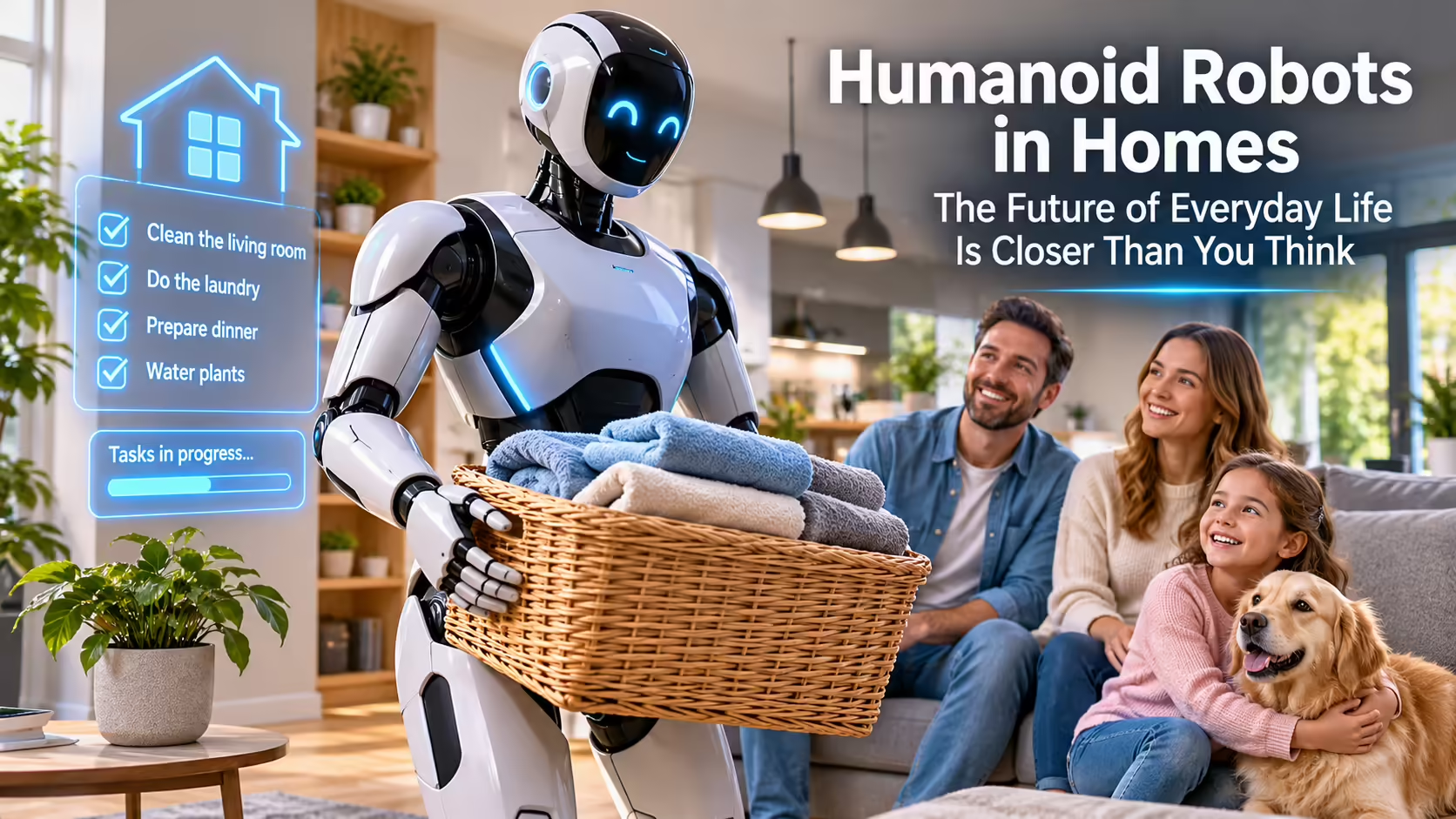
Imagine waking up in the morning and finding that your kitchen is already clean, breakfast is being prepared, your laundry has been folded, and the groceries you ordered have been put away. You have not hired a housekeeper, installed an army of smart appliances, or asked a family member for help. Instead, a humanoid robot has taken care of these tasks while you sleep.
Until recently, this scenario belonged almost exclusively to science fiction. Robots could assemble cars, transport heavy materials, vacuum floors, or perform highly specific industrial operations, but asking a machine to move naturally through a home, recognize objects, understand instructions, and carry out a variety of everyday tasks remained an enormous technological challenge.
That situation is beginning to change.
Advances in artificial intelligence, computer vision, robotics, battery technology, and mechanical engineering are bringing humanoid robots closer to practical use outside controlled industrial environments. Some are already working in factories and warehouses, while others are being developed and marketed specifically for residential use.
Companies such as Tesla, Figure AI, Agility Robotics, and 1X Technologies are competing to develop machines capable of performing physical tasks in environments designed for human beings.
The implications are enormous. If these machines become sufficiently capable and affordable, they could change how we clean our homes, care for older relatives, prepare meals, work, and organize our daily lives.
But there is a crucial distinction between building a robot that can perform a spectacular demonstration and creating one that can reliably manage an ordinary household.
The question is no longer simply whether humanoid robots will enter our homes. It is how capable they will be, how much they will cost, and how profoundly they could transform the way we live.
1. Why Are Humanoid Robots Becoming a Reality Now?
Robots have existed for decades. Industrial robotic arms have been manufacturing automobiles, electronics, and countless other products for years. So why is there suddenly so much interest in humanoid robots?
The answer lies in the convergence of several technologies that are advancing simultaneously.
Artificial intelligence gives robots the ability to understand the world
Traditional robots generally operate according to predefined instructions. An industrial robotic arm, for example, can repeatedly perform an extremely precise movement, but it does not necessarily understand what it is doing in the same way a human does.
If an object moves outside its expected position, the robot may fail unless it has been specifically programmed to handle that situation.
Modern artificial intelligence is changing this approach.
New AI systems can process visual information, recognize objects, interpret spoken instructions, understand spatial relationships, and select actions based on their surroundings.
This development is particularly important because a home is an unpredictable environment.
A chair may be moved, a door may be left open, a glass may be placed somewhere unexpected, or a child may leave toys scattered across the floor. A useful household robot must be able to adapt rather than simply repeat a programmed sequence.
Researchers and robotics companies are increasingly combining artificial intelligence with physical machines in an emerging field often called Physical AI.
Unlike a conventional chatbot, which produces information on a screen, Physical AI allows an intelligent system to interact with the physical world through cameras, sensors, motors, and mechanical components.
It is the difference between an AI that tells you how to wash the dishes and a robot that can actually pick up the plates, wash them, and put them away.
Robots are learning through experience
Another important development is the ability to train robots using demonstrations and real-world experience.
Rather than programming every movement individually, developers can show a robot how to perform a task, collect data from its movements, and use machine learning to improve its performance.
Robots can also be trained in simulated environments before being tested in physical settings.
This is essential because the number of possible situations inside a home is practically unlimited. There are different furniture arrangements, objects, lighting conditions, surfaces, and human behaviors.
A robot that can learn and generalize from experience has a much greater chance of becoming useful outside a laboratory.
Mechanical engineering is catching up with artificial intelligence
Intelligence alone is not enough.
A humanoid robot needs to walk or move safely, maintain balance, manipulate objects, apply the correct amount of force, and interact with people without causing injuries.
Developments in lightweight materials, electric motors, actuators, tactile sensors, and battery systems are making these machines increasingly sophisticated.
The most important advances are not necessarily in making robots look more human. They are in giving them the ability to perform human movements with sufficient precision, reliability, and safety.
2. Humanoid Robots Are Already Working in Factories
The transition from industrial robots to household assistants is not happening in a single technological leap. Factories and warehouses are providing an important testing ground.
Industrial environments offer something that homes do not: repetitive tasks, relatively predictable workflows, and measurable performance.
This makes them ideal places to train robots and discover their limitations.
One of the most interesting examples is the collaboration between Figure AI and BMW.
Figure AI: Robots helping manufacture cars
In November 2025, Figure AI reported the results of an extended deployment of its Figure 02 humanoid robot at BMW’s manufacturing plant in Spartanburg, South Carolina.
According to the company, the robot:
- Worked ten-hour shifts, Monday through Friday.
- Operated for more than 1,250 hours.
- Handled more than 90,000 components.
- Contributed to the production of more than 30,000 BMW X3 vehicles.
- Accumulated approximately 1.2 million steps.
Its primary task involved retrieving and positioning sheet-metal components for welding.
These figures are significant because they represent more than a laboratory demonstration. They describe a robot operating repeatedly in an actual automotive manufacturing environment.
In June 2026, BMW and Figure advanced their collaboration with the introduction of the newer Figure 03 in a different manufacturing workflow involving logistics and component sequencing.
This is an important development: humanoid robots are beginning to move beyond isolated demonstrations toward more complex industrial applications.
Agility Robotics: Robots moving goods in warehouses
Another important example is Digit, developed by Agility Robotics.
Unlike robots designed primarily to resemble humans, Digit was developed around practical industrial tasks, particularly material handling.
Its commercial deployment at GXO’s logistics facility in Flowery Branch, Georgia, provides an interesting indication of what these machines can already accomplish.
By October 2026, Agility reported that Digit had moved more than 100,000 storage totes at the facility.
The company also announced an expansion of its partnership with GXO, with deployments planned at additional facilities in North Carolina and Tennessee beginning in 2027.
This demonstrates that the commercial interest in humanoid robots is no longer limited to technology companies. Large businesses are evaluating whether these machines can deliver measurable operational benefits.
Tesla Optimus: The ambition to manufacture robots at scale
Tesla is pursuing another approach with its Optimus humanoid robot.
The company’s ambition is not simply to develop a robot capable of performing specific tasks. It wants to manufacture large numbers of humanoid robots using industrial production techniques, artificial intelligence, and technologies developed across its automotive and energy businesses.
Tesla’s October 2026 quarterly update reported that Optimus production had begun in Fremont on high-volume manufacturing lines, describing the initial machines as production-quality units. The company also identified its robotics manufacturing expansion in Texas as under development.
This is an important manufacturing milestone, although production readiness should not be confused with widespread commercial availability or proven household autonomy.
Tesla’s long-term ambition is to create robots capable of performing useful physical work in both industrial and domestic environments.
If the company succeeds in reducing manufacturing costs while improving reliability, the economics of humanoid robotics could change dramatically.
3. The First Humanoid Robots Designed Specifically for Homes
Perhaps the most significant development is that some companies are no longer treating the home as a distant possibility.
They are developing robots specifically for residential environments.
One of the clearest examples is NEO, created by the Norwegian-American robotics company 1X Technologies.
1X NEO: A humanoid robot designed to become a household assistant
NEO is particularly interesting because its design philosophy is different from that of many industrial humanoids.
Instead of focusing exclusively on manufacturing and logistics, 1X is developing a robot intended to operate in ordinary homes.
The company announced NEO in October 2025 and began accepting orders through its official website.
Its advertised specifications include:
- A weight of approximately 30 kilograms.
- A soft exterior designed for interaction with people.
- Hands with 22 degrees of freedom.
- The ability to lift more than 68 kilograms.
- A carrying capacity of approximately 25 kilograms.
- Wi-Fi, Bluetooth, and 5G connectivity.
- A voice-based interface for interacting with users.
These specifications are impressive, but the most interesting feature is its approach to artificial intelligence.
NEO uses 1X’s Redwood AI system to learn and repeat tasks. The company describes its autonomy as something that will improve over time as the robot gains experience.
However, there is an important detail that prospective buyers should understand.
For tasks that NEO cannot yet perform independently, 1X offers a scheduled Expert Mode in which a human expert can remotely supervise the robot and help it complete unfamiliar activities.
In other words, the first generation is not necessarily a completely autonomous domestic worker. It combines onboard AI capabilities with human assistance when necessary.
That distinction is essential when evaluating what today’s household robots can actually do.
How much will a household humanoid robot cost?
NEO’s announced early-access ownership price is $20,000, with a subscription option advertised at $499 per month.
The company has announced initial deliveries primarily in the United States during 2026, with plans to expand into additional markets beginning in 2027.
These prices reveal something important about the early household robotics market.
A humanoid robot is not yet an ordinary household appliance. Its price places it closer to a luxury purchase or a significant investment in domestic technology.
Nevertheless, the existence of a consumer ordering program represents a major change: humanoid robots are moving from research laboratories toward the consumer market.
The question is whether future generations will become affordable enough for ordinary households.
4. What Will a Humanoid Robot Actually Be Able to Do at Home?
The most important challenge facing household robotics is not walking on two legs or speaking naturally.
It is performing useful tasks consistently in an environment that changes every day.
Consider some of the activities that a genuinely useful domestic robot could eventually perform.
Cleaning and organizing the house
<Insert image: A humanoid robot organizing a modern living room and picking up objects.>
A household robot could potentially collect objects from the floor, organize furniture, put away clothes, empty waste bins, clean surfaces, and help maintain an orderly home.
Some tasks may be easier than others.
Picking up a large object from the floor is relatively straightforward compared with identifying different materials, handling delicate objects, folding complicated garments, or organizing an entire room according to individual preferences.
A robot must also recognize when something should not be moved.
For example, it should distinguish between a piece of rubbish and an important document, or between a dirty garment and clothing that someone has just taken off.
These seemingly simple decisions require a considerable degree of contextual understanding.
Preparing food and working in the kitchen
<Insert image: Humanoid robot preparing food in a modern home kitchen.>
The kitchen could become one of the most valuable environments for domestic robots.
A sufficiently advanced machine could retrieve ingredients, wash vegetables, prepare simple meals, operate kitchen appliances, and clean utensils.
However, kitchens present difficult challenges.
Objects are often fragile, slippery, hot, or sharp. Food preparation also involves hygiene, temperature control, and the ability to distinguish between different ingredients.
A robot that can successfully prepare a meal under controlled conditions may still struggle when faced with an unfamiliar recipe or an unexpected situation.
Nevertheless, the potential benefits are enormous, particularly for people who have limited mobility or little time to prepare meals.
Laundry and clothing management
<Insert image: Humanoid robot folding clothes beside a washing machine.>
Laundry is another task that could benefit significantly from humanoid robotics.
A household assistant could eventually:
- Collect dirty clothes.
- Separate garments according to washing requirements.
- Load washing machines.
- Transfer clothes to dryers.
- Fold and organize garments.
- Put clothing away in wardrobes.
The challenge is that fabrics behave unpredictably.
A towel, a shirt, a pair of socks, and a delicate garment all require different handling techniques.
Manipulating soft objects is one of the more difficult problems in robotics, which is why the ability to handle laundry reliably would represent an important achievement.
Shopping, deliveries, and household management
A more advanced household robot could also interact with smart-home systems, receive deliveries, organize groceries, monitor supplies, and help manage everyday routines.
Imagine arriving home with your hands full and asking your robot to put away the groceries.
Or asking it to retrieve an item from another room without having to get up.
These functions could make a significant difference in daily life, especially as robots become better at understanding natural language and recognizing objects.
Helping older people and people with disabilities
<Insert image: Friendly humanoid robot assisting an elderly person at home.>
One of the most socially important applications of domestic robotics could be assistance for older adults and people with reduced mobility.
A robot could help retrieve objects, carry groceries, remind someone about scheduled activities, operate household devices, and provide assistance with everyday routines.
It could also help people maintain greater independence for longer.
However, there is a critical distinction between assistance and medical care.
A household humanoid should not automatically be considered capable of safely lifting a person, administering medication, preventing falls, or responding to medical emergencies.
Those applications require specialized engineering, testing, and regulatory safeguards.
The most realistic initial role for domestic humanoids is likely to be practical assistance rather than replacing professional caregivers.
5. Why Is It So Difficult to Build a Robot That Can Run an Entire Household?
Watching a humanoid robot walk, talk, pick up an object, or perform a chore can create the impression that the technology is almost ready for widespread adoption.
But a successful demonstration does not necessarily mean that a machine can perform the same task reliably thousands of times.
The difference between a demonstration and a dependable product is enormous.
Human hands are extraordinarily difficult to reproduce
One of the greatest challenges is dexterity.
Human hands can manipulate objects of different sizes, shapes, textures, and weights with remarkable precision.
We can pick up an egg without breaking it, tie shoelaces, turn a key, open a plastic package, handle a fragile glass, and manipulate tiny objects.
Replicating this versatility requires sophisticated mechanical hands, tactile sensors, precise motor control, and intelligent software.
Even when a robot has advanced hands, understanding how much force to apply is a difficult problem.
Homes are unpredictable environments
Factories are generally designed around specific production processes.
Homes are not.
Every household has different furniture, appliances, lighting, obstacles, and habits. A robot must also adapt to changes that happen without warning.
A child may leave a toy in the hallway. A pet may suddenly move in front of the robot. A chair may be repositioned, or an object may fall.
A domestic robot must recognize these situations, understand their implications, and react appropriately.
Battery life and energy consumption remain important limitations
Humanoid robots require energy for movement, computing, sensors, and communication.
Walking, lifting objects, maintaining balance, and manipulating heavy loads can consume substantial amounts of power.
A household robot that needs to recharge constantly would be considerably less useful.
Manufacturers must therefore improve battery density, energy efficiency, charging systems, and the overall mechanical design.
Safety must come before convenience
A robot operating in a factory can be separated from workers or assigned to a controlled area.
A household robot will share its environment with children, elderly people, pets, and visitors.
It must be capable of recognizing potentially dangerous situations, controlling its movements, avoiding collisions, and responding safely when something goes wrong.
The safety requirements are particularly demanding when a robot is strong enough to lift heavy objects.
A machine that can lift dozens of kilograms must also be able to control that strength with extraordinary precision.
This is one reason why a soft exterior, force sensors, and carefully designed movement systems are important developments.
6. Will Humanoid Robots Replace Household Workers?
This is one of the most controversial questions surrounding the development of domestic robotics.
Cleaning, cooking, laundry, gardening, carrying objects, and household maintenance involve millions of working hours around the world.
If humanoid robots eventually become capable of performing these activities at an affordable cost, the economic consequences could be substantial.
For households, automation could reduce the time and money spent on repetitive domestic tasks.
For workers, however, the transition could be more complicated.
Some occupations may experience reduced demand, while others may change to focus on supervising, maintaining, programming, repairing, and managing robotic systems.
New employment opportunities could emerge in robotics installation, domestic automation, technical support, software development, and robot maintenance.
The transition will not necessarily happen all at once.
Initially, humanoid robots are likely to complement human workers by performing selected tasks rather than replacing every form of domestic labor.
But as their capabilities improve, the economic balance could change.
There is also a larger question: if machines eventually perform a significant proportion of the work required to maintain modern society, how will the resulting economic benefits be distributed?
The arrival of household robots is therefore not merely a technological development. It could become an important social and economic transformation.
7. How Much Will Household Humanoid Robots Cost in the Future?
Price will probably determine how quickly humanoid robots enter ordinary homes.
A technology can be extraordinarily impressive, but if only wealthy consumers can afford it, mass adoption will remain limited.
NEO’s announced $20,000 early-access price illustrates the current premium associated with consumer humanoids.
However, several factors could reduce prices over time:
Mass production: Manufacturing thousands or millions of standardized robots could reduce the cost of components and assembly.
Better batteries and motors: Improvements in energy storage, actuators, and mechanical systems could make robots cheaper and more efficient.
Artificial intelligence: More capable software could allow a single robot platform to perform many tasks without requiring expensive specialized hardware.
Competition: As more companies enter the market, manufacturers will face pressure to offer better capabilities at lower prices.
Subscription models: Instead of purchasing a robot outright, consumers may eventually pay a monthly fee that includes maintenance, software updates, and technical support.
This last possibility is particularly interesting.
A household might not need to own a robot permanently. It could subscribe to a service that provides access to a machine whenever necessary.
Such a model could make domestic robotics accessible to people who cannot afford a large initial investment.
However, the cost of servicing, repairing, insuring, and operating these machines must also be considered.
The purchase price alone will not determine whether a household robot is economically worthwhile.
8. The Privacy Problem: A Robot That Sees Everything Inside Your Home
There is another issue that deserves much more attention: privacy.
A humanoid robot designed to operate throughout a home will need to understand its surroundings.
That means using cameras, microphones, sensors, and artificial intelligence to interpret what is happening.
Unlike a stationary security camera, a mobile robot could move between rooms, observe different activities, recognize objects, and interact with family members.
It could potentially know where people keep their belongings, when they leave home, what routines they follow, and which areas of the house they use most frequently.
This creates important questions.
Who owns the information collected by a household robot?
Does the manufacturer have access to video or audio recordings?
Can remote employees connect to the robot to assist with tasks?
How is sensitive information stored and protected?
Could a compromised robot become a surveillance device inside the home?
These questions are particularly relevant for products that combine autonomous operation with remote human supervision.
For example, 1X describes an Expert Mode for NEO in which a human expert can remotely supervise certain tasks.
This feature could help a robot perform activities it has not yet mastered, but it also makes transparency and user control essential.
Before purchasing a humanoid robot, consumers should carefully examine its privacy policies, recording settings, remote-access permissions, data retention practices, and security protections.
A machine designed to make our lives easier should not require us to surrender control over our private lives.
9. When Will Humanoid Robots Become Common in Ordinary Homes?
Predicting the exact date when humanoid robots will become commonplace is difficult.
Technology companies frequently announce ambitious development schedules, but commercial success depends on much more than producing a functional prototype.
Robots must become reliable, safe, affordable, easy to maintain, and genuinely useful.
The development of household humanoids is likely to progress through several stages.
2026–2028: The first consumer generation
The initial generation of household humanoids is entering the consumer market.
Products such as 1X NEO are being offered through early-access programs, while manufacturers continue improving their AI systems and physical capabilities.
These early robots are likely to have limitations, require supervision for certain tasks, and carry premium prices.
Their importance lies in gathering real-world experience and learning how people interact with humanoid machines inside actual homes.
2028–2030: More capable household assistants
If current developments continue successfully, the next generation could become significantly more useful.
Robots may learn a broader range of domestic tasks, adapt more effectively to different homes, and require less human intervention.
Manufacturing improvements could also reduce prices, although the speed of this transition remains uncertain.
The most likely early applications will involve relatively repetitive activities such as organizing objects, transporting items, and performing selected cleaning tasks.
2030–2035: The possibility of mass adoption
By this period, humanoid robots could become a more familiar part of domestic life if manufacturers solve the major problems involving autonomy, reliability, safety, and cost.
They might function as general-purpose household assistants capable of carrying out multiple activities throughout the day.
However, this is a possible development scenario, not a guaranteed prediction.
The difference between a robot that can perform several tasks and one that can reliably manage an entire household is still substantial.
The most important factor will not be how human-like these machines look, but how much useful work they can perform without constant assistance.
10. Will We Eventually Have a Humanoid Robot in Every Home?
Consider how dramatically domestic technology has changed over the past century.
Refrigerators, washing machines, dishwashers, microwave ovens, vacuum cleaners, and personal computers were once expensive or unusual technologies.
Today, many of them are considered ordinary household equipment.
Humanoid robots could follow a similar path, although their complexity makes the comparison imperfect.
Unlike a washing machine, which performs a relatively specific function, a general-purpose humanoid robot could potentially perform dozens of different tasks.
That versatility is precisely what makes the technology so interesting.
Instead of buying a separate machine for every activity, a household might eventually have one intelligent assistant capable of handling a wide range of physical tasks.
It could clean, organize, retrieve objects, help prepare food, manage deliveries, and assist people with limited mobility.
But there is another possibility that deserves consideration.
As robots become more capable, they may change our expectations of what a home should be.
New houses could be designed with robotic assistants in mind, including charging stations, accessible storage, intelligent appliances, and furniture that is easier for machines to manipulate.
Smart homes could evolve into environments where humans and robots cooperate continuously.
The home of the future may not simply be a house filled with connected devices. It could become an environment in which artificial intelligence has a physical presence.
Conclusion: The Next Great Technological Revolution May Walk Through Your Front Door
For decades, technological progress has largely focused on making computers faster, smartphones more powerful, and the Internet more accessible.
Artificial intelligence is now taking technology beyond the digital world.
It is beginning to give machines the ability to interact with the physical environment, manipulate objects, and perform tasks that once required human hands.
Humanoid robots are one of the most ambitious expressions of this transformation.
Their journey from factories and warehouses into ordinary homes will not happen overnight. Significant challenges remain in autonomy, dexterity, safety, battery life, privacy, and affordability.
Nevertheless, the progress already demonstrated by companies such as Figure AI, Agility Robotics, Tesla, and 1X Technologies suggests that this is no longer simply a distant science-fiction concept.
The first consumer-oriented products are emerging, industrial deployments are expanding, and manufacturers are investing heavily in the technologies needed to make robots more capable and economical.
Perhaps the most important question is not whether we will eventually have robots in our homes.
It is what we will do with our lives when machines begin taking over a growing share of the physical work that has occupied human beings for centuries.
Will we have more time for family, education, creativity, and leisure? Will domestic labor become cheaper and more accessible? Will new inequalities emerge between those who can afford robotic assistance and those who cannot?
The answers will depend not only on technological progress, but also on the economic and social decisions we make along the way.
One thing is becoming increasingly clear: the next major technological revolution may not arrive through a screen or an application.
It may simply knock on your front door.
Frequently Asked Questions About Humanoid Robots in Homes
Are humanoid robots available for homes in 2026?
Yes. Consumer-oriented humanoid robots are entering the market. One example is NEO, developed by 1X Technologies, which is accepting early-access orders with announced deliveries beginning in 2026. Its capabilities and degree of autonomy remain more limited than those of a fully independent household assistant.
How much does a humanoid home robot cost?
Prices vary by manufacturer and product. 1X has advertised NEO at $20,000 for early-access ownership or through a $499 monthly subscription option. These are announced prices, not evidence that all humanoid robots are available at those prices.
What household tasks can humanoid robots perform?
Depending on their software and hardware, humanoid robots are being developed to perform tasks such as picking up objects, transporting items, organizing spaces, handling laundry, assisting with cleaning, and helping with household routines. The ability to perform these tasks independently and reliably varies considerably between models.
Can a humanoid robot cook and clean?
These are important development goals for domestic robotics. Robots can already demonstrate selected manipulation and cleaning activities, but reliably preparing complete meals and maintaining an entire home without supervision remain difficult challenges.
Are humanoid robots safe around children and pets?
Safety depends on the robot’s design, sensors, software, strength, and operating environment. Manufacturers are developing systems to improve collision avoidance and safe interaction, but consumers should not assume that every humanoid robot is suitable for unsupervised interaction with children or animals.
Will humanoid robots replace domestic workers?
They could automate some household activities and change demand for certain services. However, the extent of job displacement will depend on price, capabilities, reliability, and how quickly consumers adopt the technology.
What is the difference between a humanoid robot and a smart home device?
A smart home device usually performs a specific function, such as controlling lights, adjusting temperature, or cleaning floors. A humanoid robot is designed to move through its environment and perform multiple physical tasks using artificial intelligence, sensors, and mechanical components.
When will humanoid robots become affordable for ordinary families?
There is no reliable date. Prices could decline as manufacturing scales and technology improves, but affordability will depend on hardware costs, software, maintenance, safety requirements, and competition.